Oscar Wilde
(1854-1900)
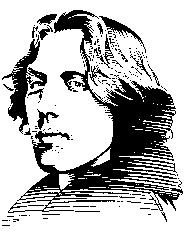 Wilde
is rightly best known for his prose and it is sometimes forgotten that
he was also a prolific poet. His poetry was of mixed quality and did not,
in my view, approach the heights that his better known writing achieved.
The best known title is The Ballad of Reading Gaol which is a poem that
surpasses every other poetic work that he produced; it contains probably
his most widely known verse lines:
Wilde
is rightly best known for his prose and it is sometimes forgotten that
he was also a prolific poet. His poetry was of mixed quality and did not,
in my view, approach the heights that his better known writing achieved.
The best known title is The Ballad of Reading Gaol which is a poem that
surpasses every other poetic work that he produced; it contains probably
his most widely known verse lines:
Yet each
man kills the thing he loves,
By each let this be heard,
Some do it with a bitter look,
Some with a flattering word,
The coward does it with a kiss,
The brave man with a sword!
He wasn't the first martyr for homesexuality but he did bring the issue forward in a time that was hugely resistant to serious discussion of homosexuality but because it was also a hugely hypocritical time: he paid a bitter price and never really recovered from his incarceration.
I offer the powerful Ballad of Reading Gaol together with Panthea which, although not a great work, does carry particular resonance for me.
(In memoriam
C. T. W.
Sometime trooper of the Royal Horse Guards
obiit H.M. prison, Reading, Berkshire
July 7, 1896)
I
He did not
wear his scarlet coat,
For blood and wine are red,
And blood and wine were on his hands
When they found him with the dead,
The poor dead woman whom he loved,
And murdered in her bed.
He walked
amongst the Trial Men
In a suit of shabby grey;
A cricket cap was on his head,
And his step seemed light and gay;
But I never saw a man who looked
So wistfully at the day.
I never
saw a man who looked
With such a wistful eye
Upon that little tent of blue
Which prisoners call the sky,
And at every drifting cloud that went
With sails of silver by.
I walked,
with other souls in pain,
Within another ring,
And was wondering if the man had done
A great or little thing,
When a voice behind me whispered low,
'THAT FELLOW'S GOT TO SWING.'
Dear Christ!
the very prison walls
Suddenly seemed to reel,
And the sky above my head became
Like a casque of scorching steel;
And, though I was a soul in pain,
My pain I could not feel.
I only knew
what hunted thought
Quickened his step, and why
He looked upon the garish day
With such a wistful eye;
The man had killed the thing he loved,
And so he had to die.
Yet each man kills the thing he loves,
By each let this be heard,
Some do it with a bitter look,
Some with a flattering word,
The coward does it with a kiss,
The brave man with a sword!
Some kill
their love when they are young,
And some when they are old;
Some strangle with the hands of Lust,
Some with the hands of Gold:
The kindest use a knife, because
The dead so soon grow cold.
Some love
too little, some too long,
Some sell, and others buy;
Some do the deed with many tears,
And some without a sigh:
For each man kills the thing he loves,
Yet each man does not die.
He does
not die a death of shame
On a day of dark disgrace,
Nor have a noose about his neck,
Nor a cloth upon his face,
Nor drop feet foremost through the floor
Into an empty space.
He does not sit with silent men
Who watch him night and day;
Who watch him when he tries to weep,
And when he tries to pray;
Who watch him lest himself should rob
The prison of its prey.
He does
not wake at dawn to see
Dread figures throng his room,
The shivering Chaplain robed in white,
The Sheriff stern with gloom,
And the Governor all in shiny black,
With the yellow face of Doom.
He does
not rise in piteous haste
To put on convict-clothes,
While some coarse-mouthed Doctor gloats,
and notes
Each new and nerve-twitched pose,
Fingering a watch whose little ticks
Are like horrible hammer-blows.
He does
not know that sickening thirst
That sands one's throat, before
The hangman with his gardener's gloves
Slips through the padded door,
And binds one with three leathern thongs,
That the throat may thirst no more.
He does
not bend his head to hear
The Burial Office read,
Nor, while the terror of his soul
Tells him he is not dead,
Cross his own coffin, as he moves
Into the hideous shed.
He does
not stare upon the air
Through a little roof of glass:
He does not pray with lips of clay
For his agony to pass;
Nor feel upon his shuddering cheek
The kiss of Caiaphas.
II
Six weeks our guardsman walked the yard,
In the suit of shabby grey:
His cricket cap was on his head,
And his step seemed light and gay,
But I never saw a man who looked
So wistfully at the day.
I never
saw a man who looked
With such a wistful eye
Upon that little tent of blue
Which prisoners call the sky,
And at every wandering cloud that trailed
Its ravelled fleeces by.
He did not
wring his hands, as do
Those witless men who dare
To try to rear the changeling Hope
In the cave of black Despair:
He only looked upon the sun,
And drank the morning air.
He did not
wring his hands nor weep,
Nor did he peek or pine,
But he drank the air as though it held
Some healthful anodyne;
With open mouth he drank the sun
As though it had been wine!
And I and
all the souls in pain,
Who tramped the other ring,
Forgot if we ourselves had done
A great or little thing,
And watched with gaze of dull amaze
The man who had to swing.
And strange
it was to see him pass
With a step so light and gay,
And strange it was to see him look
So wistfully at the day,
And strange it was to think that he
Had such a debt to pay.
For oak and elm have pleasant leaves
That in the springtime shoot:
But grim to see is the gallows-tree,
With its adder-bitten root,
And, green or dry, a man must die
Before it bears its fruit!
The loftiest
place is that seat of grace
For which all worldlings try:
But who would stand in hempen band
Upon a scaffold high,
And through a murderer's collar take
His last look at the sky?
It is sweet
to dance to violins
When Love and Life are fair:
To dance to flutes, to dance to lutes
Is delicate and rare:
But it is not sweet with nimble feet
To dance upon the air!
So with
curious eyes and sick surmise
We watched him day by day,
And wondered if each one of us
Would end the self-same way,
For none can tell to what red Hell
His sightless soul may stray.
At last
the dead man walked no more
Amongst the Trial Men,
And I knew that he was standing up
In the black dock's dreadful pen,
And that never would I see his face
In God's sweet world again.
Like two
doomed ships that pass in storm
We had crossed each other's way:
But we made no sign, we said no word,
We had no word to say;
For we did not meet in the holy night,
But in the shameful day.
A prison
wall was round us both,
Two outcast men we were:
The world had thrust us from its heart,
And God from out His care:
And the iron gin that waits for Sin
Had caught us in its snare.
III
In Debtors' Yard the stones are hard,
And the dripping wall is high,
So it was there he took the air
Beneath the leaden sky,
And by each side a Warder walked,
For fear the man might die.
Or else
he sat with those who watched
His anguish night and day;
Who watched him when he rose to weep,
And when he crouched to pray;
Who watched him lest himself should rob
Their scaffold of its prey.
The Governor
was strong upon
The Regulations Act:
The Doctor said that Death was but
A scientific fact:
And twice a day the Chaplain called,
And left a little tract.
And twice
a day he smoked his pipe,
And drank his quart of beer:
His soul was resolute, and held
No hiding-place for fear;
He often said that he was glad
The hangman's hands were near.
But why
he said so strange a thing
No Warder dared to ask:
For he to whom a watcher's doom
Is given as his task,
Must set a lock upon his lips,
And make his face a mask.
Or else
he might be moved, and try
To comfort or console:
And what should Human Pity do
Pent up in Murderers' Hole?
What word of grace in such a place
Could help a brother's soul?
With slouch and swing around the ring
We trod the Fools' Parade!
We did not care: we knew we were
The Devil's Own Brigade:
And shaven head and feet of lead
Make a merry masquerade.
We tore
the tarry rope to shreds
With blunt and bleeding nails;
We rubbed the doors, and scrubbed the floors,
And cleaned the shining rails:
And, rank by rank, we soaped the plank,
And clattered with the pails.
We sewed
the sacks, we broke the stones,
We turned the dusty drill:
We banged the tins, and bawled the hymns,
And sweated on the mill:
But in the heart of every man
Terror was lying still.
So still
it lay that every day
Crawled like a weed-clogged wave:
And we forgot the bitter lot
That waits for fool and knave,
Till once, as we tramped in from work,
We passed an open grave.
With yawning
mouth the yellow hole
Gaped for a living thing;
The very mud cried out for blood
To the thirsty asphalte ring:
And we knew that ere one dawn grew fair
Some prisoner had to swing.
Right in
we went, with soul intent
On Death and Dread and Doom:
The hangman, with his little bag,
Went shuffling through the gloom:
And each man trembled as he crept
Into his numbered tomb.
That night the empty corridors
Were full of forms of Fear,
And up and down the iron town
Stole feet we could not hear,
And through the bars that hide the stars
White faces seemed to peer.
He lay as
one who lies and dreams
In a pleasant meadow-land,
The watchers watched him as he slept,
And could not understand
How one could sleep so sweet a sleep
With a hangman close at hand.
But there
is no sleep when men must weep
Who never yet have wept:
So we - the fool, the fraud, the knave -
That endless vigil kept,
And through each brain on hands of pain
Another's terror crept.
Alas! it
is a fearful thing
To feel another's guilt!
For, right within, the sword of Sin
Pierced to its poisoned hilt,
And as molten lead were the tears we shed
For the blood we had not spilt.
The Warders
with their shoes of felt
Crept by each padlocked door,
And peeped and saw, with eyes of awe,
Grey figures on the floor,
And wondered why men knelt to pray
Who never prayed before.
All through
the night we knelt and prayed,
Mad mourners of a corse!
The troubled plumes of midnight were
The plumes upon a hearse:
And bitter wine upon a sponge
Was the savour of Remorse.
The grey cock crew, the red cock crew,
But never came the day:
And crooked shapes of Terror crouched,
In the corners where we lay:
And each evil sprite that walks by night
Before us seemed to play.
They glided
past, they glided fast,
Like travellers through a mist:
They mocked the moon in a rigadoon
Of delicate turn and twist,
And with formal pace and loathsome grace
The phantoms kept their tryst.
With mop
and mow, we saw them go,
Slim shadows hand in hand:
About, about, in ghostly rout
They trod a saraband:
And the damned grotesques made arabesques,
Like the wind upon the sand!
With the
pirouettes of marionettes,
They tripped on pointed tread:
But with flutes of Fear they filled the ear,
As their grisly masque they led,
And loud they sang, and long they sang,
For they sang to wake the dead.
'Oho!' they
cried, 'The world is wide,
But fettered limbs go lame!
And once, or twice, to throw the dice
Is a gentlemanly game,
But he does not win who plays with Sin
In the secret House of Shame.'
No things
of air these antics were,
That frolicked with such glee:
To men whose lives were held in gyves,
And whose feet might not go free,
Ah! wounds of Christ! they were living things,
Most terrible to see.
Around,
around, they waltzed and wound;
Some wheeled in smirking pairs;
With the mincing step of a demirep
Some sidled up the stairs:
And with subtle sneer, and fawning leer,
Each helped us at our prayers.
The morning
wind began to moan,
But still the night went on:
Through its giant loom the web of gloom
Crept till each thread was spun:
And, as we prayed, we grew afraid
Of the Justice of the Sun.
The moaning
wind went wandering round
The weeping prison-wall:
Till like a wheel of turning steel
We felt the minutes crawl:
O moaning wind! what had we done
To have such a seneschal?
At last
I saw the shadowed bars,
Like a lattice wrought in lead,
Move right across the whitewashed wall
That faced my three-plank bed,
And I knew that somewhere in the world
God's dreadful dawn was red.
At six o'clock
we cleaned our cells,
At seven all was still,
But the sough and swing of a mighty wing
The prison seemed to fill,
For the Lord of Death with icy breath
Had entered in to kill.
He did not
pass in purple pomp,
Nor ride a moon-white steed.
Three yards of cord and a sliding board
Are all the gallows' need:
So with rope of shame the Herald came
To do the secret deed.
We were
as men who through a fen
Of filthy darkness grope:
We did not dare to breathe a prayer,
Or to give our anguish scope:
Something was dead in each of us,
And what was dead was Hope.
For Man's
grim Justice goes its way,
And will not swerve aside:
It slays the weak, it slays the strong,
It has a deadly stride:
With iron heel it slays the strong,
The monstrous parricide!
We waited
for the stroke of eight:
Each tongue was thick with thirst:
For the stroke of eight is the stroke of Fate
That makes a man accursed,
And Fate will use a running noose
For the best man and the worst.
We had no
other thing to do,
Save to wait for the sign to come:
So, like things of stone in a valley lone,
Quiet we sat and dumb:
But each man's heart beat thick and quick,
Like a madman on a drum!
With sudden
shock the prison-clock
Smote on the shivering air,
And from all the gaol rose up a wail
Of impotent despair,
Like the sound that frightened marshes hear
From some leper in his lair.
And as one
sees most fearful things
In the crystal of a dream,
We saw the greasy hempen rope
Hooked to the blackened beam,
And heard the prayer the hangman's snare
Strangled into a scream.
And all
the woe that moved him so
That he gave that bitter cry,
And the wild regrets, and the bloody sweats,
None knew so well as I:
For he who lives more lives than one
More deaths than one must die.
IV
There is no chapel on the day
On which they hang a man:
The Chaplain's heart is far too sick,
Or his face is far too wan,
Or there is that written in his eyes
Which none should look upon.
So they
kept us close till nigh on noon,
And then they rang the bell,
And the Warders with their jingling keys
Opened each listening cell,
And down the iron stair we tramped,
Each from his separate Hell.
Out into
God's sweet air we went,
But not in wonted way,
For this man's face was white with fear,
And that man's face was grey,
And I never saw sad men who looked
So wistfully at the day.
I never
saw sad men who looked
With such a wistful eye
Upon that little tent of blue
We prisoners called the sky,
And at every careless cloud that passed
In happy freedom by.
But there
were those amongst us all
Who walked with downcast head,
And knew that, had each got his due,
They should have died instead:
He had but killed a thing that lived,
Whilst they had killed the dead.
For he who
sins a second time
Wakes a dead soul to pain,
And draws it from its spotted shroud,
And makes it bleed again,
And makes it bleed great gouts of blood,
And makes it bleed in vain!
Like ape or clown, in monstrous garb
With crooked arrows starred,
Silently we went round and round
The slippery asphalte yard;
Silently we went round and round,
And no man spoke a word.
Silently
we went round and round,
And through each hollow mind
The Memory of dreadful things
Rushed like a dreadful wind,
And Horror stalked before each man,
And Terror crept behind.
The Warders strutted up and down,
And kept their herd of brutes,
Their uniforms were spick and span,
And they wore their Sunday suits,
But we knew the work they had been at,
By the quicklime on their boots.
For where
a grave had opened wide,
There was no grave at all:
Only a stretch of mud and sand
By the hideous prison-wall,
And a little heap of burning lime,
That the man should have his pall.
For he has
a pall, this wretched man,
Such as few men can claim:
Deep down below a prison-yard,
Naked for greater shame,
He lies, with fetters on each foot,
Wrapt in a sheet of flame!
And all
the while the burning lime
Eats flesh and bone away,
It eats the brittle bone by night,
And the soft flesh by day,
It eats the flesh and bone by turns,
But it eats the heart alway.
For three long years they will not sow
Or root or seedling there:
For three long years the unblessed spot
Will sterile be and bare,
And look upon the wondering sky
With unreproachful stare.
They think
a murderer's heart would taint
Each simple seed they sow.
It is not true! God's kindly earth
Is kindlier than men know,
And the red rose would but blow more red,
The white rose whiter blow.
Out of his
mouth a red, red rose!
Out of his heart a white!
For who can say by what strange way,
Christ brings His will to light,
Since the barren staff the pilgrim bore
Bloomed in the great Pope's sight?
But neither
milk-white rose nor red
May bloom in prison-air;
The shard, the pebble, and the flint,
Are what they give us there:
For flowers have been known to heal
A common man's despair.
So never
will wine-red rose or white,
Petal by petal, fall
On that stretch of mud and sand that lies
By the hideous prison-wall,
To tell the men who tramp the yard
That God's Son died for all.
Yet though the hideous prison-wall
Still hems him round and round,
And a spirit may not walk by night
That is with fetters bound,
And a spirit may but weep that lies
In such unholy ground,
He is at
peace - this wretched man -
At peace, or will be soon:
There is no thing to make him mad,
Nor does Terror walk at noon,
For the lampless Earth in which he lies
Has neither Sun nor Moon.
They hanged
him as a beast is hanged:
They did not even toll
A requiem that might have brought
Rest to his startled soul,
But hurriedly they took him out,
And hid him in a hole.
They stripped
him of his canvas clothes,
And gave him to the flies:
They mocked the swollen purple throat,
And the stark and staring eyes:
And with laughter loud they heaped the shroud
In which their convict lies.
The Chaplain
would not kneel to pray
By his dishonoured grave:
Nor mark it with that blessed Cross
That Christ for sinners gave,
Because the man was one of those
Whom Christ came down to save.
Yet all
is well; he has but passed
To Life's appointed bourne:
And alien tears will fill for him
Pity's long-broken urn,
For his mourners will be outcast men,
And outcasts always mourn
V
I know not whether Laws be right,
Or whether Laws be wrong;
All that we know who lie in gaol
Is that the wall is strong;
And that each day is like a year,
A year whose days are long.
But this
I know, that every Law
That men have made for Man,
Since first Man took his brother's life,
And the sad world began,
But straws the wheat and saves the chaff
With a most evil fan.
This too
I know - and wise it were
If each could know the same -
That every prison that men build
Is built with bricks of shame,
And bound with bars lest Christ should see
How men their brothers maim.
With bars
they blur the gracious moon,
And blind the goodly sun:
And they do well to hide their Hell,
For in it things are done
That Son of God nor son of Man
Ever should look upon!
The vilest deeds like poison weeds,
Bloom well in prison-air;
It is only what is good in Man
That wastes and withers there:
Pale Anguish keeps the heavy gate,
And the Warder is Despair.
For they
starve the little frightened child
Till it weeps both night and day:
And they scourge the weak, and flog the fool,
And gibe the old and grey,
And some grow mad, and all grow bad,
And none a word may say.
Each narrow
cell in which we dwell
Is a foul and dark latrine,
And the fetid breath of living Death
Chokes up each grated screen,
And all, but Lust, is turned to dust
In Humanity's machine.
The brackish
water that we drink
Creeps with a loathsome slime,
And the bitter bread they weigh in scales
Is full of chalk and lime,
And Sleep will not lie down, but walks
Wild-eyed, and cries to Time.
But though lean Hunger and green Thirst
Like asp with adder fight,
We have little care of prison fare,
For what chills and kills outright
Is that every stone one lifts by day
Becomes one's heart by night.
With midnight
always in one's heart,
And twilight in one's cell,
We turn the crank, or tear the rope,
Each in his separate Hell,
And the silence is more awful far
Than the sound of a brazen bell.
And never
a human voice comes near
To speak a gentle word:
And the eye that watches through the door
Is pitiless and hard:
And by all forgot, we rot and rot,
With soul and body marred.
And thus
we rust Life's iron chain
Degraded and alone:
And some men curse, and some men weep,
And some men make no moan:
But God's eternal Laws are kind
And break the heart of stone.
And every human heart that breaks,
In prison-cell or yard,
Is as that broken box that gave
Its treasure to the Lord,
And filled the unclean leper's house
With the scent of costliest nard.
Ah! happy
they whose hearts can break
And peace of pardon win!
How else may man make straight his plan
And cleanse his soul from Sin?
How else but through a broken heart
May Lord Christ enter in?
And he of the swollen purple throat,
And the stark and staring eyes,
Waits for the holy hands that took
The Thief to Paradise;
And a broken and a contrite heart
The Lord will not despise.
The man
in red who reads the Law
Gave him three weeks of life,
Three little weeks in which to heal
His soul of his soul's strife,
And cleanse from every blot of blood
The hand that held the knife.
And with
tears of blood he cleansed the hand,
The hand that held the steel:
For only blood can wipe out blood,
And only tears can heal:
And the crimson stain that was of Cain
Became Christ's snow-white seal.
VI
In Reading gaol by Reading town
There is a pit of shame,
And in it lies a wretched man
Eaten by teeth of flame,
In a burning winding-sheet he lies,
And his grave has got no name.
And there,
till Christ call forth the dead,
In silence let him lie:
No need to waste the foolish tear,
Or heave the windy sigh:
The man had killed the thing he loved,
And so he had to die.
And all
men kill the thing they love,
By all let this be heard,
Some do it with a bitter look,
Some with a flattering word,
The coward does it with a kiss,
The brave man with a sword!
Nay,
let us walk from fire unto fire,
From passionate pain to deadlier delight,-
I am too young to live without desire,
Too young art thou to waste this summer night
Asking those idle questions which of old
Man sought of seer and oracle, and no reply was told.
For sweet,
to feel is better than to know,
And wisdom is a childless heritage,
One pulse of passion-youth's first fiery glow,-
Are worth the hoarded proverbs of the sage:
Vex not thy soul with dead philosophy,
Have we not lips to kiss with, hearts to love, and eyes to see!
Dost thou
not hear the murmuring nightingale
Like water bubbling from a silver jar,
So soft she sings the envious moon is pale,
That high in heaven she hung so far
She cannot hear that love-enraptured tune,-
Mark how she wreathes each horn with mist, yon late and laboring moon.
White lilies,
in whose cups the gold bees dream,
The fallen snow of petals where the breeze
Scatters the chestnut blossom, or the gleam
Of all our endless sins, our vain endeavour
Enough for thee, dost thou desire more?
Alas! the Gods will give naught else from their eternal store.
For our
high Gods have sick and wearied grown
Of boyish limbs in water,- are not these
For wasted days of youth to make atone
By pain or prayer or priest, and never, never,
Hearken they now to either good or ill,
But send their rain upon the just and the unjust at will.
They sit
at ease, our Gods they sit at ease,
Strewing with leaves of rose their scented wine,
They sleep, they sleep, beneath the rocking trees
Where asphodel and yellow lotus twine,
Mourning the old glad days before they knew
What evil things the heart of man could dream, and dreaming do.
And far
beneath the brazen floor, they see
Like swarming flies the crowd of little men,
The bustle of small lives, then wearily
Back to their lotus-haunts they turn again
Kissing each other's mouths, and mix more deep
The poppy-seeded draught which brings soft purple-lidded sleep.
There all
day long the golden-vestured sun,
Their torch-bearer, stands with his torch a-blaze,
And when the gaudy web of noon is spun
By its twelve maidens through the crimson haze
Fresh from Endymion's arms comes forth the moon,
And the immortal Gods in toils of mortal passions swoon.
There walks
Queen Juno through some dewy mead,
Her grand white feet flecked with the saffron dust
Of wind-stirred lilies, while young Ganymede
Leaps in the hot and amber-foaming must,
His curls all tossed, as when the eagle bare
The frightened boy from Ida through the blue Ionian air.
There in
the green heart of some garden close
Queen Venus with the shepherd at her side,
Her warm soft body like the brier rose
Which would be white yet blushes at its pride,
Laughs low for love, till jealous Salmacis
Peers through the myrtle-leaves and sighs for pain of lonely bliss.
There never
does that dreary northwind blow
Which leaves our English forests bleak and bare,
Nor ever falls the swift white-feathered snow,
Nor doth the red-toothed lightning ever dare
To wake them in the silver-fretted night
When we lie weeping for some sweet sad sin, some dead delight.
Alas! they
know the far Lethaean spring,
The violet-hidden waters well they know,
Where one whose feet with tired wandering
Are faint and broken may take heart and go,
And from those dark depths cool and crystalline
Drink, and draw balm, and sleep for sleepless souls, and anodyne.
But we oppress
our natures, God or Fate
Is our enemy, we starve and feed
On vain repentance- O we are born too late!
What balm for us in bruised poppy seed
Who crowd into one finite pulse of time
The joy of infinite love and the fierce pain of infinite crime.
O we are
wearied of this sense of guilt,
Wearied of pleasures paramour despair,
Wearied of every temple we have built,
Wearied of every right, unanswered prayer,
For man is weak; God sleeps: and heaven is high:
One fiery-colored moment: one great love: and lo! we die.
Ah! but
no ferry-man with laboring pole
Nears his black shallop to the flowerless strand,
No little coin of bronze can bring the soul
Over Death's river to the sunless land,
Victim and wine and vow are all in vain,
The tomb is sealed; the soldiers watch; the dead rise not again.
We are resolved
into the supreme air,
We are made one with what we touch and see,
With our heart's blood each crimson sun is fair,
With our young lives each spring-impassioned tree
Flames into green, the wildest beasts that range
The moor our kinsmen are, all life is one, and all is change.
With beat
of systole and of diastole
One grand great light throbs through earth's giant heart,
And mighty waves of single Being roll
From nerve-less germ to man, for we are part
Of every rock and bird and beast and hill,
One with the things that prey on us, and one with what we kill.
From lower
cells of waking life we pass
To full perfection; thus the world grows old:
We who are godlike now were once a mass
Of quivering purple flecked with bars of gold,
Unsentient or of joy or misery,
And tossed in terrible tangles of some wild and wind-swept sea.
This hot
hard flame with which our bodies burn
Will make some meadow blaze with daffodil,
Ay! and those argent breasts of thine will turn
To water-lilies; the brown fields men till
Will be more fruitful for our love to-night,
Nothing is lost in nature, all things live in Death's despite.
The boy's
first kiss, the hyacinth's first bell,
The man's last passion, and the last red spear
That from the lily leaps, the asphodel
Which will not let its blossoms blow for fear
Of too much beauty, and the timid shame
Of the young bridegroom at his lover's eyes,- these with the same
One sacrament
are consecrate, the earth
Not we alone hath passions hymeneal,
The yellow buttercups that shake for mirth
At daybreak know a pleasure not less real
Than we do, when in some fresh-blossoming wood
We draw the spring into our hearts, and feel that life is good.
So when
men bury us beneath the yew
Thy crimson-stained mouth a rose will be,
And thy soft eyes lush bluebells dimmed with dew,
And when the white narcissus wantonly
Kisses the wind its playment, some faint joy
Will thrill our dust, and we will be again fond maid and boy.
And thus
without life's conscious torturing pain
In some sweet flower we will feel the sun,
And from the linnet's throat will sing again,
And as two gorgeous-mailed snakes will run
Over our graves, or as two tigers creep
Through the hot jungle where the yellow-eyed huge lions sleep
And give
them battle! How my heart leaps up
To think of that grand living after death
In beast and bird and flower, when this cup,
Being filled too full of spirit, bursts for breath,
And with the pale leaves of some autumn day
The soul earth's earliest conqueror becomes earth's last great prey.
O think
of it! We shall inform ourselves
Into all sensuous life, the goat-foot Faun,
The Centaur, or the merry bright-eyed Elves
That leave their dancing rings to spite the dawn
Upon the meadows, shall not be more near
Than you and I to nature's mysteries, for we shall hear
The thrush's
heart beat, and the daisies grow,
And the wan snowdrop sighing for the sun
On sunless days in winter, we shall know
By whom the silver gossamer is spun,
Who paints the diapered fritillaries,
On what wide wings from shivering pine to pine the eagle flies.
Ay! had
we never loved at all, who knows
If yonder daffodil had lured the bee
Into its gilded womb, or any rose
Had hung with crimson lamps its little tree!
Methinks no leaf would ever bud in spring,
But for the lovers' lips that kiss, the poet's lips that sing.
Is the light
vanished from our golden sun,
Or is this daedal-fashioned earth less fair,
That we are nature's heritors, and one
With every pulse of life that beats the air?
Rather new suns across the sky shall pass,
New splendour come unto the flower, new glory to the grass.
And we two
lovers shall not sit afar,
Critics of nature, but the joyous sea
Shall be our raiment, and the bearded star
Shoot arrows at our pleasure! We shall be
Part of the mighty universal whole,
And through all aeons mix and mingle with the Kosmic Soul!
We shall
be notes in that great Symphony
Whose cadence circles through the rhythmic spheres,
And all the live World's throbbing heart shall be
One with our heart, the stealthy creeping years
Have lost their terrors now, we shall not die,
The Universe itself shall be our Immortality!